College of Natural Sciences and Mathematics

Home / Academics / Colleges and Institutes / College of Natural Sciences and Mathematics

College of Natural Sciences and Mathematics

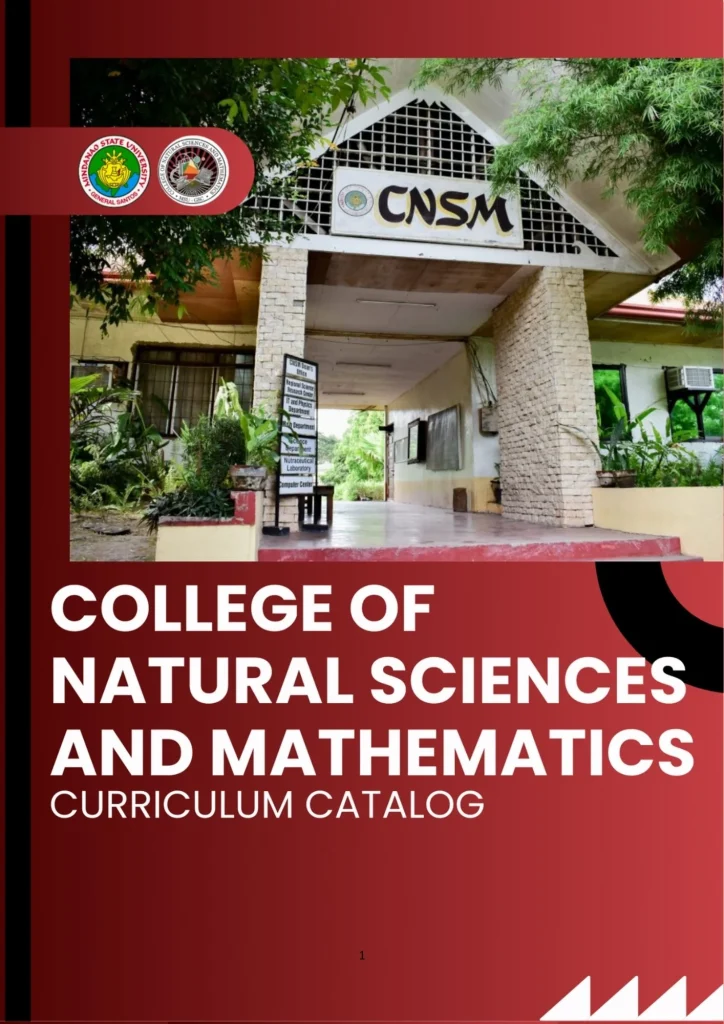
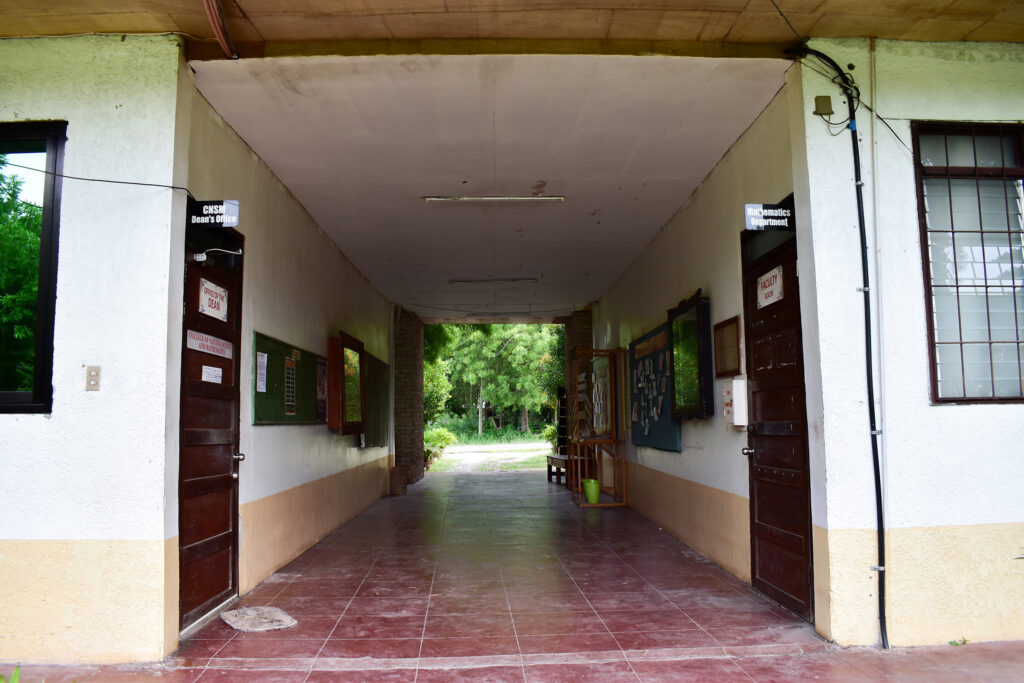
The College of Natural Sciences and Mathematics serves as one of the university’s academic institutions dedicated to the advancement of scientific knowledge, mathematical understanding, and research-driven education in the natural sciences. The college is committed to developing competent, analytical, and innovative graduates who are equipped with strong foundations in science and mathematics and who can contribute to academic, technological, and societal development.
More specifically, the college offers academic programs that cover disciplines such as biology, chemistry, physics, and mathematics, emphasizing both theoretical understanding and practical application. It facilitates laboratory work, research initiatives, and academic training that enhance students’ scientific reasoning, quantitative skills, and problem-solving abilities. The college also engages in extension activities and collaborative research that address scientific and environmental challenges, promote STEM education, and support community development. Furthermore, it contributes to the university’s mission of academic excellence by fostering a culture of inquiry, innovation, and evidence-based learning in the fields of natural sciences and mathematics.
Department Chairpersons​ / Program Coordinators

Assoc. Prof. Berlita Y. Disca, PhD

Assoc. Prof. Berlita Y. Disca, PhD

Mathematics
Assoc. Prof. Ronaldo T. Bigsang, MS

Assoc. Prof. Ronaldo T. Bigsang, MS

Science
Asst. Prof. Putlih Adzra T. Pautong, MS, RCh

Asst. Prof. Putlih Adzra T. Pautong, MS, RCh

Chemistry
Prof. Lumer Jude P. Doce, DIT

Prof. Lumer Jude P. Doce, DIT

IT and Physics / Master of Science in Information Technology
Assoc. Prof. Maria Luisa N. Cabrera, MS

Assoc. Prof. Maria Luisa N. Cabrera, MS

Master of Science in Biology
Prof. Mae P. Militante, PhD

Prof. Mae P. Militante, PhD

Master of Science in Mathematics
Prof. Edward R. Lapong, PhD

Prof. Edward R. Lapong, PhD

Master/Doctor in Sustainable Development Studies

Undergraduate Programs

The Bachelor of Science in Biology curriculum offers a major in General Biology with four proposed tracks: Biodiversity, Animal Biology, Microbiology and Plant Biology. As of 2020, Microbiology and Animal Biology tracks are currently offered by the Science department. The BS Biology major in Biodiversity curriculum provides a deeper understanding of the diversity of life, with emphasis on the assessment of the diversity and conservation status of Philippine biodiversity, understanding factors governing the diversity, distribution, evolution, and ecology of floral and faunal species in both terrestrial and aquatic environments, as well as looking into global trends and issues that affect biodiversity loss, and formulate conservation strategies. The BS Biology major in Animal Biology curriculum prepares students for advanced studies (Master’s/PhD in Animal Science, human and veterinary medicine, and other related fields). Career options include teacher, researcher, field biologist, public educator, conservationists, policymakers, animal and wildlife educator, wildlife rehabilitator, animal keeper and curator. The BS Biology major in Microbiology curriculum will provide anin-depth understanding of key concepts of prokaryotes, microbial structure and biodiversity, microbial functions and genetics, and microbial impacts on human lives- food production, industrial products, pharmaceuticals, and effects on humans, animals and plants. The BS Biology major in Plant Biology curriculum encompasses traditional studies of whole-plant biology with consideration of recent advances in areas such as biodiversity, systematic, evolutionary biology, ecology, and ethnobotany. The BS Biology curriculum provides a deeper understanding in the many aspects of animal life (Animal Biology major), plant life (Plant Biology major), microbial life (Microbiology major) and the diversity of life (Biodiversity major). It gives more emphasis on the fields of systematics, taxonomy, ecology, genetics, evolutionary biology, morphoanatomy, physiology and molecular biology. During the first two years, students will be exposed to the application of technology in the processing of data. The integration of lecture and laboratory classes will allow maximal exposure of students to hands-on experiences, showcasing their individual learning capacity translated into creative skills and talents as well as training them to work in teams, bringing out their individual potential in performing group tasks even in the lecture classes. The laboratory portion is reinforced by more hands-on activities which will be done both in the classroom and in the field. Every major course incorporates updates from most recent scientific studies. Students will have practicum for one summer term and a total of three (3) semesters for the undergraduate thesis. Throughout their course work, students will be taught different methods of exploration, investigation, organization of data and how they are utilized in practical life. Graduates can be employed in both private and public institutions or they can opt to start their own business.

➤ Program Prospectus

Recognized as the “Central Science,” chemistry serves as a critical link among disciplines such as biology, physics, and earth sciences. Its integrative nature enables it to connect and support advancements across the scientific spectrum. Chemistry is a fundamental branch of the natural sciences concerned with the study of matter—its composition, structure, properties, and the transformations it undergoes. It encompasses the investigation, modification, and quantification of the physical, chemical, and biochemical characteristics of substances.

➤ Program Prospectus

The Bachelor of Science in Information Technology program includes the study of the utilization of both hardware and software technologies involving planning, installing, customizing, operating, managing and administering, and maintaining information technology infrastructure that provides computing solutions to address the needs of an organization. The program prepares graduates to address various user needs involving the selection, development, application, integration and management of computing technologies within an organization. Through BOR Resolution No. 129, Series of 2018, the new curriculum of the BSIT program was approvedcompliant to the CHED CMO No. 25 Series of 2015. The program offers 2 major tracks – the Database Systems and the Network Systems. The curriculum has 156 units that includes the required General Education, common ITE, professional and domain specific courses.

➤ Program Prospectus

The Bachelor of Science in Mathematics program offering was approved through BOR Res. No. 1889 series of 1979. Through BOR Res. No. 357 series of 2017, the new curriculum was authorized conforming to the CMO No.48 series of 2017. BS Mathematics new curriculum offers two tracks, the Education track which has a total of 149.5 units and Statistics track with 151 units. The curriculum covers the professional and technical preparation of the graduates. The students have an option to take an education, statistics, or an advanced Mathematics subjects. Graduates of BS Mathematics can teach high school math courses or tertiary level/service courses and can also obtain jobs in finance, actuarial science, operations research, risk management, business and economics, banking and finance, computing and information technology or can pursue graduate studies.

➤ Program Prospectus

The Bachelor of Science in Physics (BS Physics) is an undergraduate program designed to provide students with comprehensive and rigorous training in physics as a foundation for careers in basic and applied physics or interdisciplinary sciences. Graduates of the program are expected to work in the academe, hospitals as medical physicist, power plants as nuclear physicist, industries such as quality assurance personnel, scientist in the R&D division, and as inventor and businessmen for their established projects/products.

➤ Program Prospectus

Graduate Programs

The Master of Science in Biology is a graduate program designed to deepen students’ understanding of the biological sciences through advanced coursework, research, and practical application. It aims to develop professionals with strong analytical, research, and scientific communication skills capable of addressing biological and environmental issues through innovative and sustainable solutions. The program emphasizes independent and collaborative research in various fields of biology, including ecology, genetics, microbiology, physiology, and biodiversity conservation. Upon completion, graduates are expected to demonstrate expertise in biological research, teaching, and professional practice in academic, governmental, or industrial settings.

➤ Program Prospectus

The Master of Science in Information Technology (MSIT) program is designed to equip professionals with skills and knowledge in various IT fields to promote peace and development. The course of study is concentrated on the following areas of discipline but not limited to eHealth, eGovernment, eSociety, and eEducation. It also embraces allied fields such as data science, cybersecurity, software engineering, and information systems management, recognizing their integral role in strengthening the IT discipline and its applications across sectors.

➤ Program Prospectus

The Master of Science in Mathematics program is designed to strengthen the mathematical expertise of educators, researchers, and professionals in mathematics-related fields. It offers rigorous coursework in core areas such as real analysis, modern algebra, topology, and linear algebra, providing a strong theoretical foundation. The program also includes specialized electives and research-focused components to enhance analytical and problem-solving skills essential for advanced academic and professional applications.

➤ Program Prospectus

The Master in Sustainable Development Studies is an interdisciplinary graduate program designed to equip professionals and researchers with the knowledge, skills, and values needed to promote sustainable and inclusive growth. It emphasizes the integration of environmental protection, economic viability, and social equity in policymaking and development practice. The program aims to produce competent and ethical leaders capable of formulating innovative solutions to sustainability challenges at local, national, and global levels. Graduates are prepared to engage in research, policy development, and program implementation that advance the principles of sustainable development.

➤ Program Prospectus

The Master in Sustainable Development Studies is an interdisciplinary graduate program designed to equip professionals and researchers with the knowledge, skills, and values needed to promote sustainable and inclusive growth. It emphasizes the integration of environmental protection, economic viability, and social equity in policymaking and development practice. The program aims to produce competent and ethical leaders capable of formulating innovative solutions to sustainability challenges at local, national, and global levels. Graduates are prepared to engage in research, policy development, and program implementation that advance the principles of sustainable development.

➤ Program Prospectus

The Master in Sustainable Development Studies is an interdisciplinary graduate program designed to equip professionals and researchers with the knowledge, skills, and values needed to promote sustainable and inclusive growth. It emphasizes the integration of environmental protection, economic viability, and social equity in policymaking and development practice. The program aims to produce competent and ethical leaders capable of formulating innovative solutions to sustainability challenges at local, national, and global levels. Graduates are prepared to engage in research, policy development, and program implementation that advance the principles of sustainable development.

➤ Program Prospectus

The Master in Sustainable Development Studies is an interdisciplinary graduate program designed to equip professionals and researchers with the knowledge, skills, and values needed to promote sustainable and inclusive growth. It emphasizes the integration of environmental protection, economic viability, and social equity in policymaking and development practice. The program aims to produce competent and ethical leaders capable of formulating innovative solutions to sustainability challenges at local, national, and global levels. Graduates are prepared to engage in research, policy development, and program implementation that advance the principles of sustainable development.

➤ Program Prospectus

The Doctor in Sustainable Development Studies is an interdisciplinary doctoral program designed to cultivate leaders, scholars, and innovators committed to advancing sustainability across environmental, social, and economic dimensions. It aims to develop critical thinkers and change agents capable of addressing complex global challenges through research-based policies, responsible governance, and sustainable innovations. The program emphasizes systems thinking, evidence-based decision-making, and the integration of science, technology, and community engagement in promoting inclusive and resilient development. Graduates are expected to contribute to sustainable solutions and leadership in academia, industry, government, and international development organizations.

➤ Program Prospectus
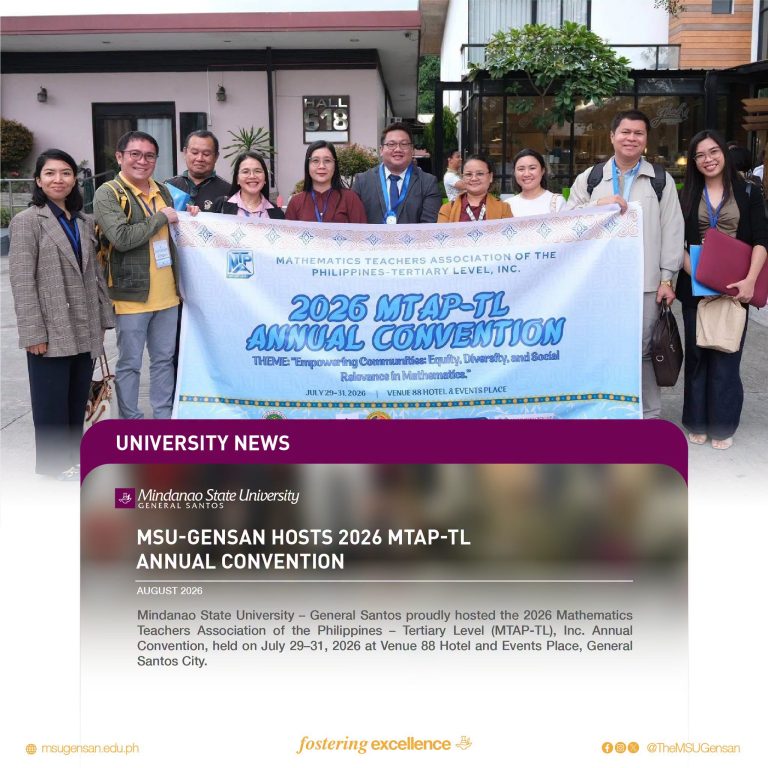
MSU-GenSan honors Math Confluence 2026 winners, receives DILG recognition during Flag Ceremony
Read More